
The Government Has Now Answered for the Agent Inside the Church. Its Answer Is a Floor Plan.
The government says sending an undercover agent into a protected church broke no order, because he was in the gymnasium and not the sanctuary. A judge has told it to explain.
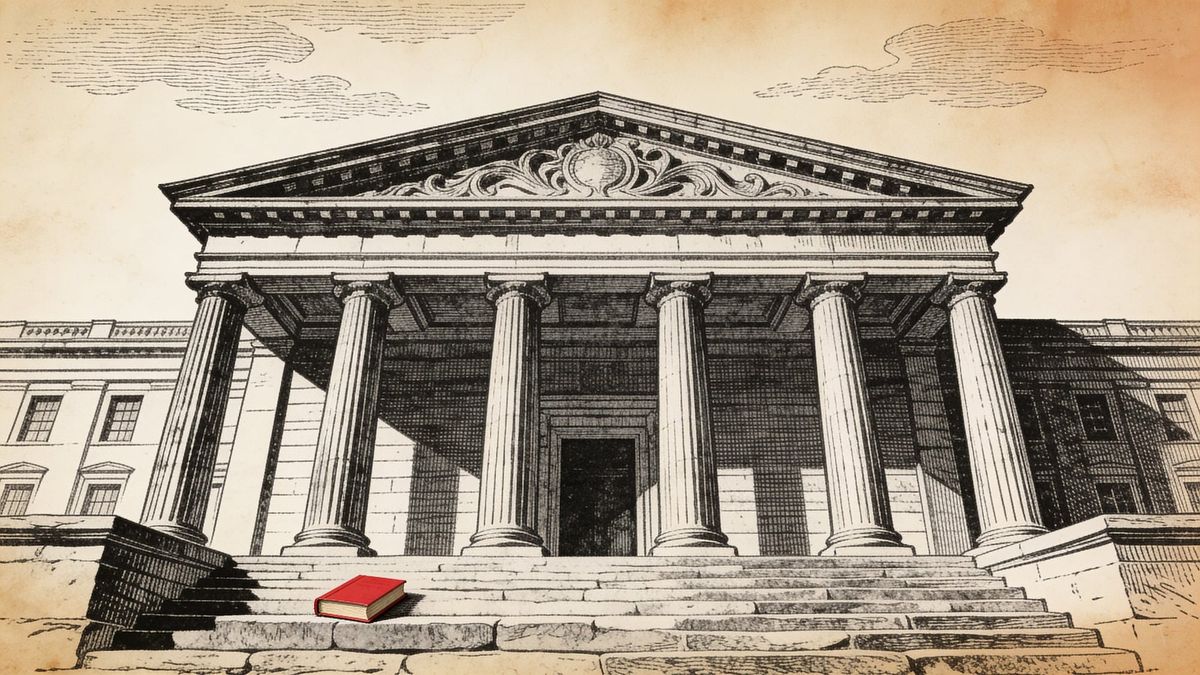
Six days ago the question was whether a federal agent had gone into a Minneapolis church covered by a court order. That part was never really in dispute. The question was what the government would say about it.
Now we know. In a filing dated August 23, the government argued that sending an undercover officer into University Baptist Church did not violate the injunction, because the officer was in the gymnasium rather than the sanctuary, and because what was happening in the church that day was not, in the government's word, "central" to the church's mission.
On August 24, one day later and four days after the churches moved for it, a federal judge in the District of Massachusetts ordered the government to show cause why it should not be held in contempt.
Strip the case to its principle and it is not complicated. Either a house of worship is a protected place, or the government decides which of its rooms and which of its hours qualify.
Start with what the order actually does, because that is where the panic and the celebration both live.
In February, in New England Synod, Evangelical Lutheran Church in America v. Department of Homeland Security, a federal court issued a preliminary injunction running sixty two pages. It bars warrantless immigration enforcement on the grounds of the plaintiff churches, with an exception for exigent circumstances. The plaintiffs are eleven religious bodies, among them American Baptist Churches USA and several regional bodies of the Evangelical Lutheran Church in America. They are represented by Democracy Forward, the Washington Lawyers' Committee for Civil Rights and Urban Affairs, and Gilbert LLC.
University Baptist Church in Minneapolis is affiliated with two of the plaintiffs. It posted signs on the building reading that the premises are a protected area pursuant to a federal court order in New England Synod v. Department of Homeland Security. In May, according to court records, an undercover Immigration and Customs Enforcement officer went inside anyway and spent roughly two hours in the church gymnasium recording the people at a martial arts class. The government appears to have regarded the class as connected to anti-enforcement organizing in Minnesota.
On August 20 the churches filed a motion alleging "multiple egregious violations" and asking the court to order the government to explain itself. That motion is what produced this week's answer.
Now concede the government's fair point, because there is one, and an argument that will not state it is not an argument.
An injunction has edges. Courts do have to decide what a protected area covers. If a congregation owns a parking structure six blocks away, nobody thinks a court order turned it into a chapel. Line drawing here is real work, and the churches have to accept some version of it or the order becomes a jurisdiction rather than a protection.
But look closely at the test the government has proposed, because it is not a boundary test. It is a significance test.
The first half asks where in the building the agent stood. The plaintiffs' answer is short and hard to get around: the gymnasium is inside the church building, directly beneath the sanctuary, and the building was designated as a place of worship under the order rather than as some adjacent facility.
The second half is the part that should hold your attention long after this docket closes. The government argued that the use of the church that day was not central to the church's mission. That asks a federal agency to rank a congregation's own activities by how religious they are, and then to enter the ones that score too low.
Consider who else that test would reach. A mosque's after school tutoring. A synagogue's classroom on a weekday. A Baptist food pantry on a Tuesday morning. Under this reading, none of it is protected, because none of it is worship in the narrow sense, and an official downtown gets to say so. The liberty you claim on Sunday is worth exactly what it is worth to the congregation down the road on Tuesday, and if it does not cover them it will not cover you either.
As the plaintiffs put it, once a location has been properly designated, its protection does not vary from hour to hour based on what the government believes is happening inside at that moment. A protection the government may remeasure room by room is not a protection. It is a permission.
Two honest cautions before you carry this anywhere.
An order to show cause is not a finding of contempt. It compels an explanation. The court has not ruled that the injunction was violated, and it may yet accept some part of the government's reading. Anyone telling you this week that ICE has been held in contempt is ahead of the record.
And the government has not argued this in public. A DHS spokesperson told Religion News Service the agency does not comment on ongoing investigations or investigative methods, and referred questions to the United States Attorney for the District of Minnesota, who did not respond. What we have is a filing, not an explanation.
Watch September for the response. Then go look at how your own congregation is designated, if it is designated at all, and by what document. That sign on the door in Minneapolis was accurate. It named a real order in a real case. It did not stop anyone from walking in, and the answer now on the record is that the room was the wrong room.
The Red Lighthouse is reader funded. This piece is free to read and free to send to anyone who needs it.
Sources
- Baptist News Global, Jeff Brumley, "DHS claims it did not violate court order by spying on Baptist church," August 26, 2026. Link
- Religion News Service, Jack Jenkins, "11 faith groups accuse Trump administration of violating court order while spying on churches," August 20, 2026. Link
- Plaintiffs' motion for an order to show cause, New England Synod, ELCA v. DHS, No. 4:25-cv-40102 (D. Mass.), Dkt. 117. Link
- Preliminary injunction, February 2026, same docket, Dkt. 74. Link
- Democracy Forward, statement of President Skye Perryman. Link
- Religion News Service, "DHS, probing anti-ICE activists, spied on at least five Midwest churches, court records indicate," August 19, 2026. Link
Comments ()