
Everyone Will Call This the Day Washington Agreed to Pay for Worship. Read the Opinion. It Is Nearly Forty Pages About Whether a Federal Clerk May Decide What Counts as Worship.
The Justice Department told HHS the old bar on spending grant money for sectarian worship, instruction or proselytization violates the Free Exercise Clause. What the opinion holds, what it concedes, and why a memo is not a ruling.
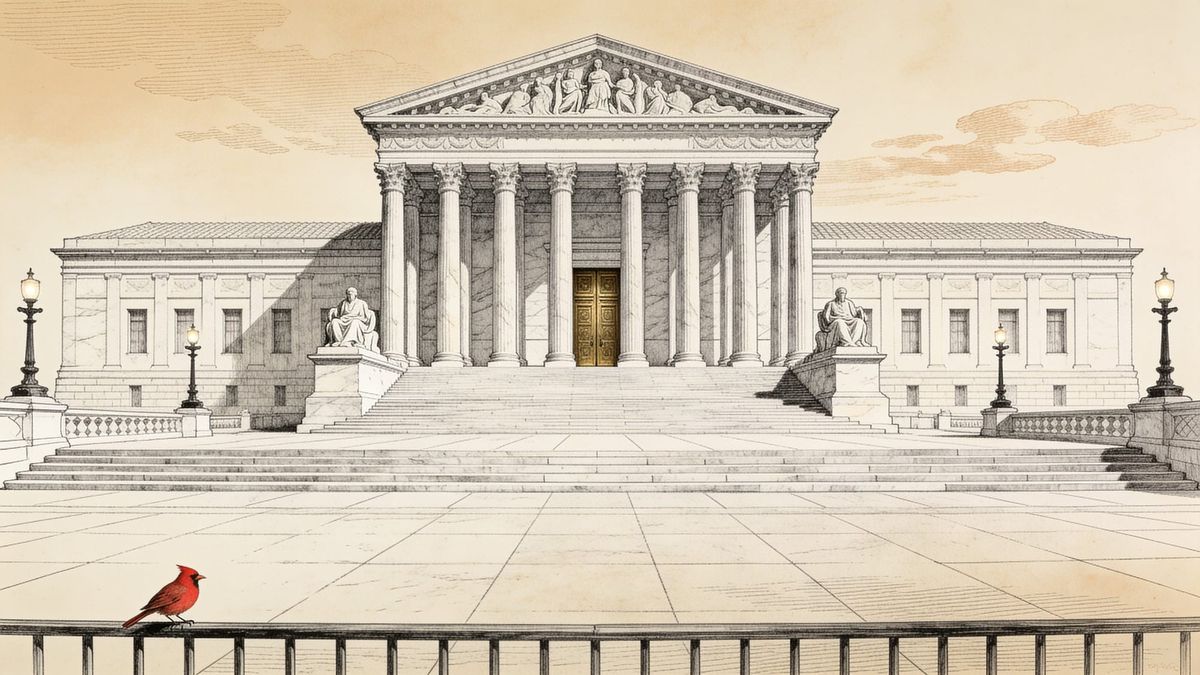
Strip the opinion to its principle and it is not complicated. When the government opens a program to everyone, it may not close it to a provider because of what the provider believes or how the provider prays. That principle is now the position of the executive branch, in a memorandum opinion from the Justice Department's Office of Legal Counsel dated August 25 and reported this week as the moment Washington agreed to fund religion.
Define the terms first. The Office of Legal Counsel does not decide cases. It answers legal questions for federal agencies, and its answers bind those agencies unless a court says otherwise. On July 1 the Department of Health and Human Services asked it about three statutes that govern money HHS sends to charities: the welfare reform law of 1996, the Public Health Service Act, and the Child Care and Development Block Grant Act. Each carries a version of the same sentence. No funds "shall be expended for sectarian worship, instruction, or proselytization."
HHS asked whether the Establishment Clause requires that sentence, and if not, whether the Free Exercise Clause permits it. The office answered no to both.
First Liberty called it "a major victory for religious liberty." The Freedom From Religion Foundation said the First Amendment "does not require the government to bankroll prayer, preaching or proselytizing." Both are right about something. Neither sentence describes what the opinion held.
Begin with what changed
In 2019 the same office looked at a federal loan program for historically Black colleges that excluded buildings "predominantly used for devotional religious activity," and upheld the exclusion. Its reasoning came from Locke v. Davey, the 2004 case that let Washington State deny a scholarship to a student training for the ministry. The 2019 opinion drew a line: the government may not discriminate against a religious institution for what it is, but it may decline to pay for what it does.
Three cases erased that line. Espinoza v. Montana in 2020 held that Montana could not exclude religious schools from a scholarship program. Carson v. Makin in 2022 held that Maine could not exclude them from a tuition program by relabeling the exclusion as a limit on religious use. Kennedy v. Bremerton School District, the same year, buried the Lemon test. The new opinion says that anything in the 2019 opinion inconsistent with those cases "is no longer the view of our Office, or of the Executive Branch." Carson came down in June 2022. HHS asked its question in July 2026. Four years.
What the opinion actually holds
Three rules. Strict scrutiny applies whenever a generally available benefit is denied because of religion, whether the trigger is what the recipient is or how it will use the money. A funding condition that makes a religious provider suppress its religious exercise as the price of admission is that kind of denial. And sorting activities into "worship," "instruction," and "proselytization" is itself suspect, because it makes a federal clerk into a theologian.
That third rule is the one to keep. The opinion leans on Catholic Charities Bureau v. Wisconsin, the unanimous 2025 decision that struck down a state's attempt to decide which Catholic charities were religious enough for a tax exemption. A rule that funds a Baptist soup kitchen so long as nobody prays over the soup requires someone in Washington to decide when a blessing becomes a sermon.
Concede the fair point
The Freedom From Religion Foundation is correct that nothing in the Constitution obliges Congress to fund worship. What Congress may not do, on the office's reading, is fund the shelter, the addiction program and the pre-kindergarten class, then dock the one provider whose staff opens with prayer. The word the opinion uses is "presumptively," which means strict scrutiny, not automatic defeat. A compelling interest could still save a restriction. The office found none here.
Locke v. Davey is still the law. The opinion says it survives, "if at all," only for vocational religious degrees, and it cites a Fourth Circuit concurrence from this year calling Locke "a moth-eaten shell of its former self." That concurrence came in Hall v. Fleming, the case we covered in August: the student who lost Locke is now the lawyer asking the Supreme Court to overrule it. The petition is pending.
The pluralist move
If this rule holds, it holds for everyone. The mosque that runs a job training program under the welfare law may open the class with the Fatiha. The Christian who cheers this opinion should cheer that too, because a liberty that reaches the church only because a friendly administration wrote the memo is not liberty. It is favor, and favor changes hands.
That is also the caution. An opinion of the Office of Legal Counsel binds the executive branch and no one else. The next administration can withdraw it the way this one withdrew 2019. The statutes stay on the books until Congress strikes them or the Supreme Court settles the question. If HHS stops enforcing the restrictions it must tell Congress within thirty days. Watch for that report.
The quotable version: the government may decide whether to fund the soup kitchen, but not whether the cook may pray.
Read the opinion, not the headlines. Then ask your own congregation's ministries whether they have ever scrubbed a program to qualify for a grant. And if this piece helped you see the difference between a court ruling and a memo, pass it to someone who needs the distinction. It is free to share.
Sources
- Office of Legal Counsel, U.S. Department of Justice, "Constitutionality of Religious Restrictions on the Use of Federal Funds," memorandum opinion for the Director of the Office for Civil Rights, HHS, August 25, 2026 (signed T. Elliot Gaiser and Joshua J. Craddock): https://www.justice.gov/olc/opinion/constitutionality-religious-restrictions-use-federal-funds (PDF: https://www.justice.gov/olc/media/1459056/dl)
- Deseret News, Reagan Campbell, "Three Supreme Court cases killed the legal case for restricting religious charities. The DOJ finally agreed," September 14, 2026: https://www.deseret.com/politics/2026/09/14/doj-opinion-religious-restrictions-federal-funds/
- Catholic News Agency via National Catholic Register, Daniel Payne, "Department of Justice Says Government Can't Restrict Funding Based on Religious Status," August 29, 2026: https://www.ncregister.com/cna/doj-religious-funding
- Office of Legal Counsel, "Religious Restrictions on Capital Financing for Historically Black Colleges and Universities," 43 Op. O.L.C. 191 (2019): https://www.justice.gov/olc/file/1350166/dl
- Statutes at issue: 42 U.S.C. 604a(j); 42 U.S.C. 290kk-2 and 300x-65(i); 42 U.S.C. 9858k(a) and 9858l(a)(4).
- The Red Lighthouse, "The Lawyer Asking the Supreme Court to Overrule Locke v. Davey Is the Student Who Lost It," August 16, 2026: https://www.theredlighthouse.org/advocate-hall-locke-davey/

Comments ()