
Luther's First Thesis Said the Whole Christian Life Is Repentance. Most Octobers I Celebrate the Hammer Instead.
Martin Luther's first thesis, sent on October 31, 1517, says the entire life of believers is to be one of repentance. We celebrate the hammer every Reformation Day. A reflection on the hinge instead.
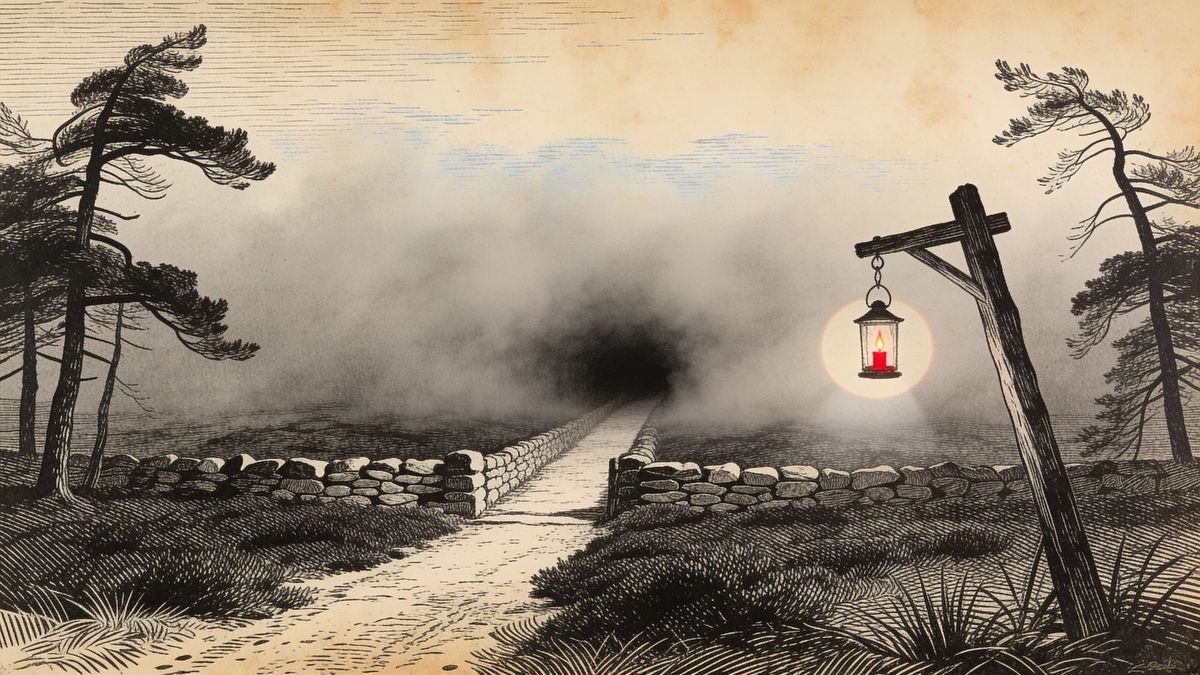
Every October someone in my church posts a picture of a hammer.
A heavy wooden door, a sheet of paper, a monk with his arm raised. I always like it, because I like the story: a man walks up to a church in Wittenberg on October 31, 1517, and changes the world with a nail.
I have liked that story for years. I have never once liked the first sentence on the paper.
Here it is, in the English most of us read it in: "When our Lord and Master Jesus Christ said, 'Repent,' he willed the entire life of believers to be one of repentance."
That is thesis one of ninety five. Luther wrote them in Latin, as a set of points for academic debate, and on that same October 31 he sent them in a letter to Albert, the Archbishop of Mainz. Whether he also nailed them to the church door is a question historians still argue about. The popular account says he did. The earliest claim that he posted them came from his colleague Philip Melanchthon, and it does not sit easily with some of Luther's own statements. The hammer may be the part we invented.
The first thesis is the part we skip.
I understand why. The hammer is a story about someone else's corruption. It points outward, at a church selling pardons and an archbishop paying for his office. It lets me stand on the right side of the door. The first thesis points the other way. It does not say the Church in Rome must repent. It says the believer must, and not once, at an altar call, but for the entire life. Every day. The man reaching for the nail included.
The next two theses press harder. This repentance cannot be reduced to the sacrament of penance as the clergy administered it, Luther says, and it cannot be only an inward feeling either. You cannot outsource it to a priest. You cannot keep it private in your head.
That leaves me with nowhere to hide. I am a Protestant who celebrates the Reformation the way some people celebrate the founding of a team: with loyalty, with a little contempt for the other side, and with almost no change in how I spend a Tuesday.
Jesus did say it. "Repent, for the kingdom of heaven is at hand." It is the first word of His public preaching in Matthew 4. John the Baptist said it before Him. Peter said it at Pentecost. It always means the same unglamorous thing: turn around.
It is not a hammer. It is a hinge.
I think that is why the first thesis has never trended. A hinge is not dramatic. It does not make a sound you can photograph. It is the small piece of iron that lets a door open, over and over. A door with no hinge is a wall, however beautiful the wood.
So this year I am trying something small. Between now and October 31 I am reading the first four theses each morning before I read anything else, and then asking one question: what did I turn away from yesterday, and what do I need to turn away from today? Most mornings the answer is ordinary: a sharp word, a phone at dinner, a prayer I promised and did not pray.
None of that will make a good picture. That is the point. The Reformation did not begin with a man who was sure he was right. It began with a man who wrote that the whole life of a Christian is turning, and then put his own name at the bottom.
The door in the picture is still beautiful. I hope someone posts it again this week.
I hope we read what was on the paper.
If this was worth your morning, forward it to one person you would want to read the first thesis with. And if you are not yet a member, The Morning Watch comes free to your inbox every day.
Sources
- Ninety five Theses, text and history (date, letter to Albert of Mainz, Latin original, Melanchthon's account): Wikipedia
- Martin Luther's 95 Theses, full English text: Bible Study Tools
- Stephen Nichols, "What Is Reformation Day?" (the popular account of October 31, 1517, and Albert of Mainz): Ligonier Ministries
- Scripture: Matthew 3:2, Matthew 4:17, Acts 2:38

Comments ()